Quantum
As the need for GNSS-independent navigation systems becomes increasingly critical in industrial, scientific, and military sectors—particularly in subsea environments—quantum sensing emerges as a revolutionary solution.
The Challenge
GNSS signals are often unavailable or unreliable during underwater operations and deep-sea exploration, rendering traditional navigation methods inadequate. Q-NAVIUM addresses these challenges by leveraging Nitrogen-Vacancy (NV) centers in diamonds, which offer:
- High Sensitivity: Superior precision in magnetic and inertial sensing.
- Miniaturization: Compact design suitable for integrated naval platforms.
- Robustness: Reliability in demanding and extreme maritime environments.
Project Specifications
The project has been submitted to the Public-Private Collaboration Fund to secure additional financing for its execution.
- Project Nature: Experimental Development.
- Target Maturity: Finalization at TRL 6 (Technology Readiness Level 6).
- Duration: September 2025 – August 2028 (36 months).
- Budget: €1.12 Million.
- Human Capital: Creation of 3 direct high-skilled positions.
Strategic Roadmap
Q-NAVIUM is structured into five core activities designed to meet ambitious technical milestones:
- Core Hardware Development: Designing the magnetometer and gyroscope based on NV-center technology.
- Algorithm Innovation: Developing new control protocols and algorithms to meet strict naval operational requirements.
- Prototyping: Building an integrated system for magnetic anomaly detection and navigation for maritime vehicles.
- Field Validation: Execution of comprehensive test campaigns to validate the prototype in real-world scenarios.
- Consortium Synergy: Combining expertise in quantum physics, materials science, and naval engineering to push the boundaries of current technology.
Impact
By overcoming the limitations of conventional sensors and GNSS-based systems, Q-NAVIUM will redefine the standards for surface and underwater navigation, ensuring operational continuity where traditional technologies fail.
Quantum Navigation for Naval Environments

Papers
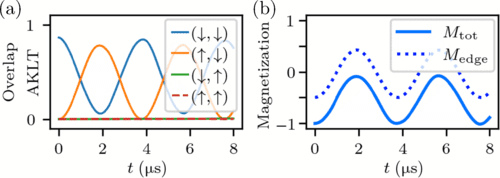
Spin-1 Haldane Phase in a Chain of Rydberg Atoms
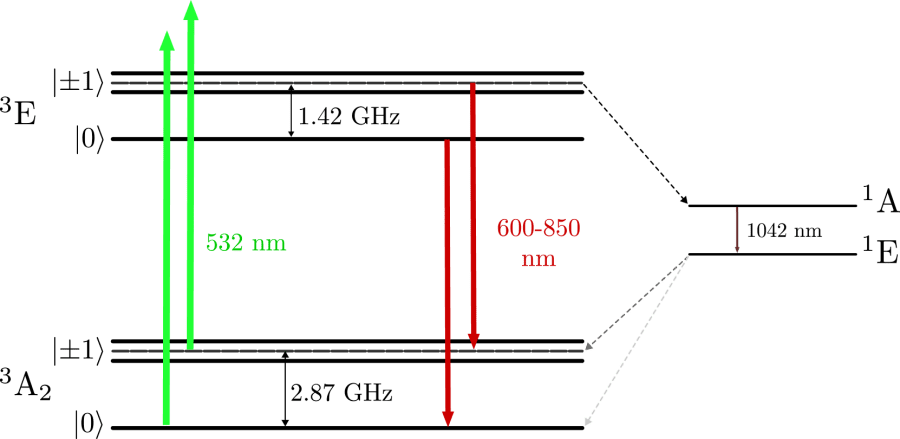
Optimization and characterization of laser excitation for quantum sensing with single nitrogen-vacancy centres
Room-Temperature Quantum Simulation with Atomically Thin Nuclear Spin Layers in Diamond
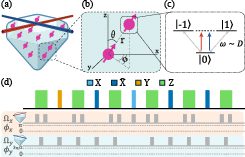
Zero-field dipolar decoupling of color center ensembles via universal qutrit control