Deep Learning Models for Realistic Multicomponent Signal Modulation Classification
Agustín M. Galante-Cervino, Alberto Martínez-Fernandez, Adrián Colomer, Valery Naranjo, Carlos García-Meca
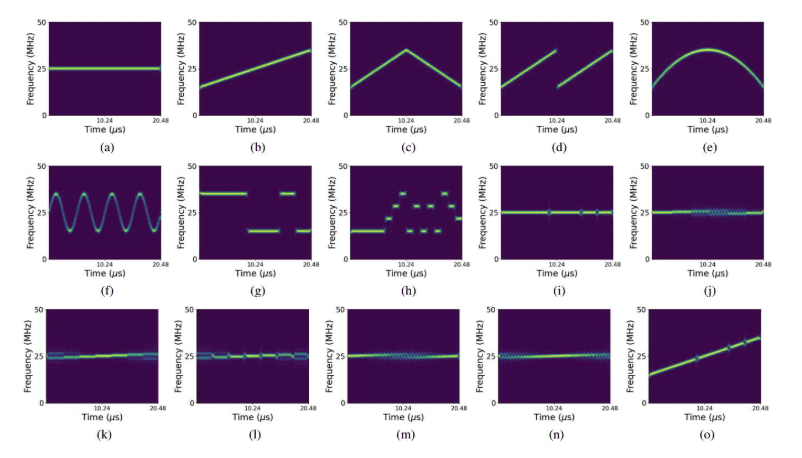
In this work, we study the application of three recent computer vision architectures to the classification of the modulation type of single- and dual-component signals, making emphasis on their usage in a realistic context by simultaneously considering a wide variety of modulations while varying the number of components. In order to do so, we first generate synthetic signal reception data of 15 modulation types, used for training and testing small variants of these models, chosen such that throughput is maximized and latency minimized, since we consider the context of a time-sensitive application. Given enough training compute, and in the single-component case, all convolutional models obtain an accuracy of 95% or more when signal-to-noise ratio (SNR) is at least 0 dB, and one variant obtains 90% accuracy at -3 dB. In the dual-component case, convolutional models manage upwards of 95% when SNR is at least 12 dB, and more than 90% when SNR is at least 6 dB. Finally, we also measure their throughput and latency as a function of batch size (important parameters for applications such as radar and communication systems), with a convolutional model variant yielding the highest throughput at 14432 samples per second. Based on the obtained results, our work paves the way towards the classification of modern complex modulation schemes and provides selection rules for the most appropriate algorithm depending on the performance feature to be optimized (such as throughput and size).



Related papers
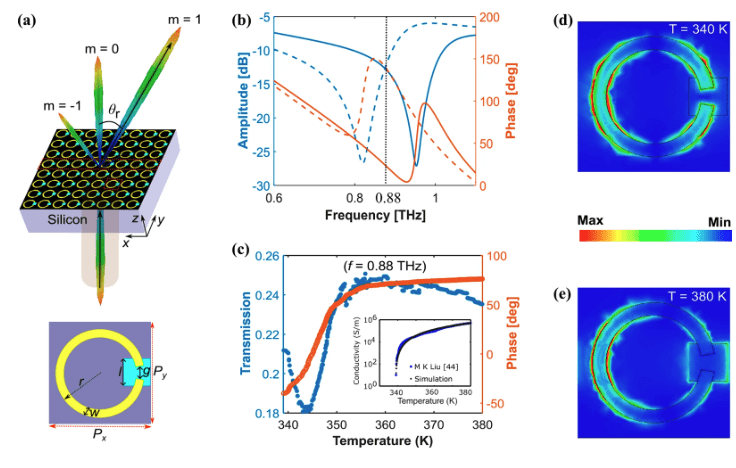
Metasurface based on phase change materials for electrically reconfigurable THz beam steering in copolarized transmission mode
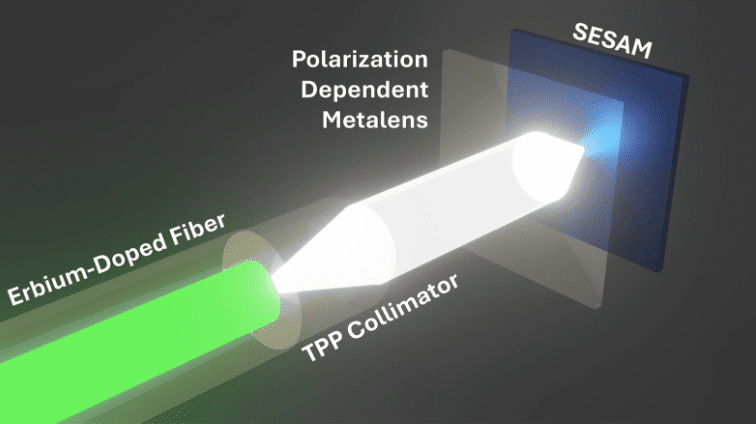
Modeling a metalens-based system for GHz fiber mode-locked lasers
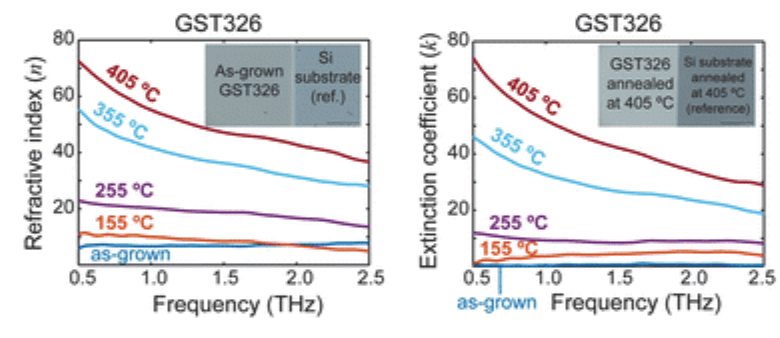
Terahertz spectroscopic characterization of Ge3Sb2Te6 compounds for active applications