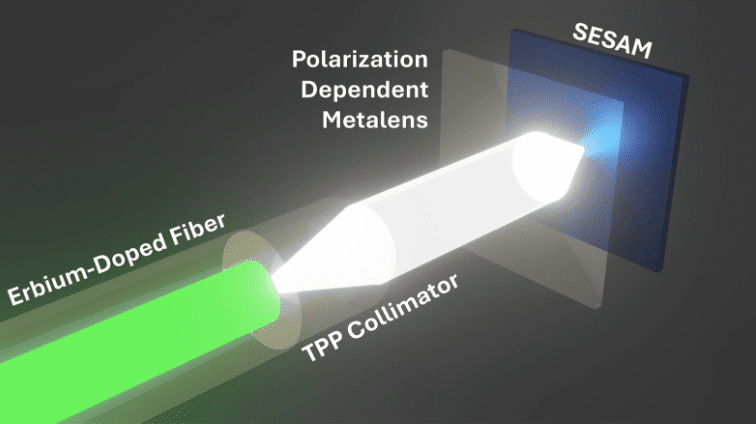
Fiber-based passive mode-locked lasers (MLLs) are a well-established technology for high-speed optical communications, capable of generating ultrashort pulses with high energy. While most commercial MLLs operate at repetition rates around 100 MHz, increasing this frequency to the GHz range introduces significant challenges, including polarization control, efficient saturation of the saturable absorber, heat dissipation and the achievement of a high free spectral range (FSR). To address these limitations, we propose a system consisting of a metalens and a 3D-printed fiber-tip collimator. The metalens is designed to selectively focus one polarization while diverging the orthogonal component, thereby addressing the polarization control. To enhance its performance and increase tolerance to positional offsets and angular tilts, we fabricated a fiber-tip collimator using two-photon polymerization (TPP). Our model suggests that this integrated system could enable the miniaturization of fiber-based MLLs while controlling polarization, enhancing the efficiency of the saturable absorber through better heat dissipation, and increasing the FSR with a shorter fiber length.




Related papers
Terahertz spectroscopic characterization of Ge3Sb2Te6 compounds for active applications
Deep Learning Models for Realistic Multicomponent Signal Modulation Classification
Metasurface based on phase change materials for electrically reconfigurable THz beam steering in copolarized transmission mode